Post #1: Defective Grantor Trusts: Revenue Ruling 2011-28 Offers Further Comfort For Intentionally Defective Grantor Trust Planning (4 Pages)
FREE SIEGEL POST: In order to obtain this Free Posting,
1. click the above "Add To Cart"
2. proceed with Checkout and then
3. if you already have an account, merely login or if you do not yet have an account, just create an account.
You do NOT need to enter any credit card information unless you are purchasing forms from other sections of this site.
DEFECTIVE GRANTOR TRUSTS: One of the most attractive tax and estate planning techniques presently available is the intentionally defective grantor trust. A very popular planning technique which has been used to achieve "ideal" defective grantor trust power has been the administrative power described in Code Section 675(4)(C) i.e. the power retained by the grantor and exercisable in a nonfiduciary capacity to reacquire the trust corpus by substituting other property of an equivalent value.
FREE SIEGEL POST: In order to obtain this Free Posting,
1. click the above "Add To Cart"
2. proceed with Checkout and then
3. if you already have an account, merely login or if you do not yet have an account, just create an account.
You do NOT need to enter any credit card information unless you are purchasing forms from other sections of this site.
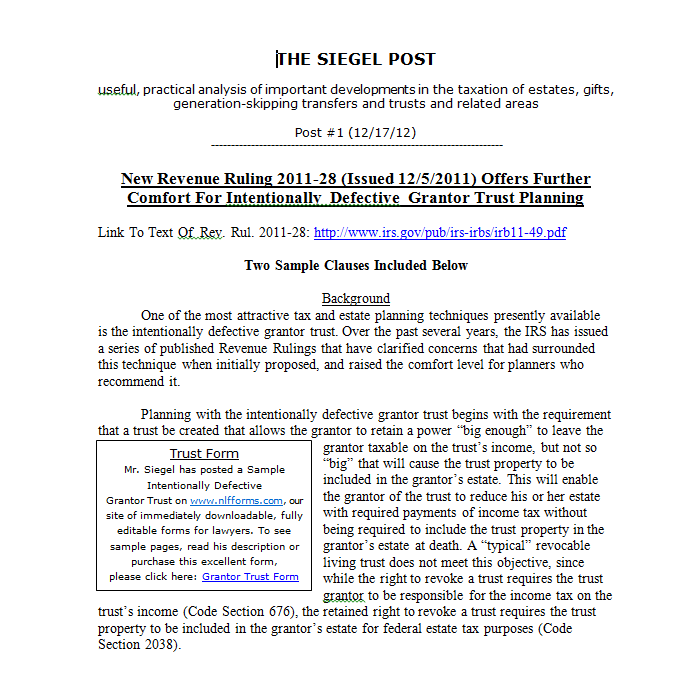
DEFECTIVE GRANTOR TRUSTS: One of the most attractive tax and estate planning techniques presently available is the intentionally defective grantor trust. A very popular planning technique which has been used to achieve "ideal" defective grantor trust power has been the administrative power described in Code Section 675(4)(C) i.e. the power retained by the grantor and exercisable in a nonfiduciary capacity to reacquire the trust corpus by substituting other property of an equivalent value.
Revenue Ruling 2011-28, issued November 5, 2011, addresses the issue of whether the grantor's retention of the nonfiduciary power to acquire a life insurance policy on the grantor's life, where the trust holds a life insurance policy on the grantor's life, causes the policy to be included in the grantor's estate.
In this posting, Mr. Siegel explains the Revenue Ruling. Importantly, he also gives useful drafting and planning suggestions including two (2) recommended Sample Trust Provisions.
Related Form: Please click on "Trusts" on the home page and scroll down to: "Intentionally Defective Trust Forms: Intentionally Defective Grantor Trust (7 Pages), Installment Sale To Trust (3 Pages) and Promissory Note For Sale To Defective Grantor Trust (2 Pages)"
Related CLE Course: Would you like to listen to, and earn CLE credits for, a course on this and/or related topics? If so, please go to www.nlfonline.com for our online CLE courses available 24/7 and to www.nlfcle.com for our CLE courses on Audio CD, DVD and CD-ROM. On both of these web sites, click on your state (or any state if you do not care about earning CLE credits) and scroll down to the course title(s) which interest you.
Author:
Steven G. Siegel is president of The Siegel Group, which provides consulting services to attorneys, accountants, business owners, family offices and financial planners. Based in Morristown, New Jersey, the Group provides services throughout the United States.
Mr. Siegel is the author of many books, including: The Grantor Trust Answer Book (2012 and 2013 CCH); CPA’s Guide to Financial and Estate Planning (AICPA 2012); and Federal Fiduciary Income Taxation (Foxmoor 2012).
In conjunction with numerous tax planning lectures he has delivered for the National Law Foundation, Mr. Siegel has prepared extensive lecture materials on the following subjects: Planning for An Aging Population; Business Entities: Start to Finish; Preparing the Audit-Proof Federal Estate Tax Return; Business Acquisitions: Representing Buyers and Sellers in the Sale of a Business; Dynasty Trusts; Planning with Intentionally-Defective Grantor Trusts, Introduction to Estate Planning; Intermediate-Sized Estate Planning; Social Security, Medicare and Medicaid: Explanation and Planning Strategies; Subchapter S Corporations: Using Trusts as Shareholders; Divorce and Separation: Important Tax Planning Issues; The Portability Election; Generation-Skipping Transfer Tax: A Comprehensive Review; and many other titles.
Mr. Siegel has delivered hundreds of lectures to thousands of attendees in live venues and via webinars throughout the United States on tax, business and estate planning topics on behalf of numerous organizations, including The Heckerling Institute on Tax Planning, CCH, National Law Foundation, AICPA, Western CPE, the National Society of Accountants, the National Tax Institute, Cohn-Reznick, Professional Education Systems, Inc., Foxmoor Education, many State Accounting Societies and Estate Planning Councils as well as on behalf of private companies.
He is presently serving as an adjunct professor of law in the Graduate Tax Program (LLM) of the University of Alabama, and has served as an adjunct professor of law at Seton Hall and Rutgers University law schools.
Mr. Siegel holds a bachelor’s degree from Georgetown University (magna cum laude, phi beta kappa), a juris doctor from Harvard Law School and an LLM in taxation from New York University Law School.