
Just Portability (3-Page Fully- Editable Form and 21-Page Downloadable Book)
SAVE when you purchase these two products:
Fully-Editable Form: Portability Election for Estates and Trusts - 4 Alternative Clauses (3 Pages)
This Form provides alternative Portability Clauses to be used in connection with a Will or Trust. The concept of Portability was introduced in the 2010 Tax Relief Act (as new Code Section 2010 (c)) as a way to permit an election to be made for the unused federal estate tax exemption of a decedent to pass to his or her surviving spouse so the spouse could utilize the exemption. The Portability rules introduce a new phrase into the estate planning lexicon, the “deceased spousal unused exemption amount” which will be used in the Forms suggested below.
Portability was made permanent by the American Tax Relief Act of 2012 (ATRA). The IRS has recently issued guidance requiring that in order to elect Portability, the executor of the decedent’s estate must file a timely and complete federal estate tax return. The filing of the return, absent an affirmative election out of the Portability election on the filed return, is deemed a making of the Portability election. Failure to file Form 706 will result in a denial of the Portability opportunity.
In many cases, Portability will be favored to insure use of the maximum federal transfer tax exemptions for both spouses of a marriage. In some situations, it will not be favored, either because other planning techniques are preferred (such as a full funding of the available applicable exclusion at the death of the first spouse to die) or as the result of a desire to deny the surviving spouse the use of the decedent’s unused exclusion for further transfers.
At the present time, Portability is only allowed with respect to the federal estate tax exemption, and not that of any state. However, in the event the Portability concept is adopted by a state, the language of the Forms below allows for a state Portability election as well.
Alternative #1 provides for the mandatory election of portability by the executor of the decedent’s estate.
Alternative #2 addresses the possibility that no executor is appointed for the estate (such as where the entire estate plan of the decedent is contained in a revocable trust) and then the trustee is directed to make the portability election.
Alternative #3 gives the executor the discretion to make the portability election.
Alternative #4 gives the trustee the discretion to make the portability election.
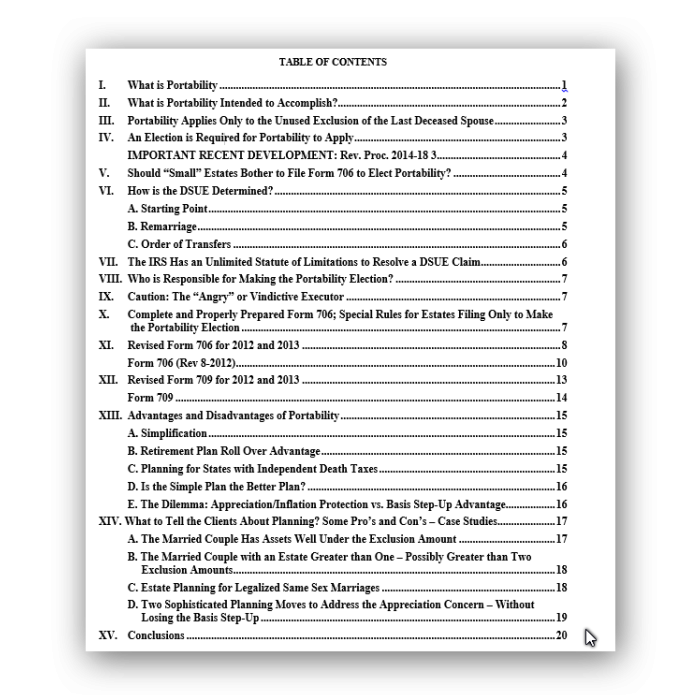
Book To Download: Portability: An Estate Planning Game-Changer (21 Pages)
See sample pages above including the complete Table Of Contents.
Author:
Steven G. Siegel is president of The Siegel Group, which provides consulting services to attorneys, accountants, business owners, family offices and financial planners. Based in Morristown, New Jersey, the Group provides services throughout the United States. Mr. Siegel is the author of many books, including: The Grantor Trust Answer Book (2012 and 2013 CCH); CPA’s Guide to Financial and Estate Planning (AICPA 2012); and Federal Fiduciary Income Taxation (Foxmoor 2012). In conjunction with numerous tax planning lectures he has delivered for the National Law Foundation, Mr. Siegel has prepared extensive lecture materials on the following subjects: Planning for An Aging Population; Business Entities: Start to Finish; Preparing the Audit-Proof Federal Estate Tax Return; Business Acquisitions: Representing Buyers and Sellers in the Sale of a Business; Dynasty Trusts; Planning with Intentionally-Defective Grantor Trusts, Introduction to Estate Planning; Intermediate-Sized Estate Planning; Social Security, Medicare and Medicaid: Explanation and Planning Strategies; Subchapter S Corporations: Using Trusts as Shareholders; Divorce and Separation: Important Tax Planning Issues; The Portability Election; Generation-Skipping Transfer Tax: A Comprehensive Review; and many other titles. Mr. Siegel has delivered hundreds of lectures to thousands of attendees in live venues and via webinars throughout the United States on tax, business and estate planning topics on behalf of numerous organizations, including The Heckerling Institute on Tax Planning, CCH, National Law Foundation, AICPA, Western CPE, the National Society of Accountants, the National Tax Institute, Cohn-Reznick, Professional Education Systems, Inc., Foxmoor Education, many State Accounting Societies and Estate Planning Councils as well as on behalf of private companies. He is presently serving as an adjunct professor of law in the Graduate Tax Program (LLM) of the University of Alabama, and has served as an adjunct professor of law at Seton Hall and Rutgers University law schools. Mr. Siegel holds a bachelor’s degree from Georgetown University (magna cum laude, phi beta kappa), a juris doctor from Harvard Law School and an LLM in taxation from New York University Law School.