2012, 2013 And Beyond Drafting Issues–16 Will And Trust Clauses To Address 4 Important Issues On CD-ROM (39 Pages)
Your CD-ROM will be shipped to you within 24 hours of puchase.
You will receive 16 clauses addressing these 4 issues:
ISSUE 1: The Marital Deduction Provisions
ISSUE 2: The Credit Shelter Trust Provisions (aka By-Pass Trust; aka Unified Credit Trust, aka Exemption Equivalent Trust)
ISSUE 3: Portability Provisions
ISSUE 4: Generation-Skipping Transfers
BONUS INCLUSION: You also receive a suggested 2012 Estate and Tax Client Planning Letter.
*RELATED CLE COURSES, "2012 And Beyond: Estate And Tax Planning Including Portability" by Steven G. Siegel. Go to www.nlfonline.com for the online course available 24/7 and to www.nlfcle.com for the course on Audio CD or DVD. On both web sites, for CLE credits, please click on your state (or any state if you don't care about getting CLE credits) and then, under "Estate Planning", and scroll down to this title. (This course is not available for New York CLE Credits.)
Your CD-ROM will be shipped within 24 hours of purchase.
The 2010 Tax Reform Act introduced the largest exemptions from estate, gift and generation-skipping tax that have ever been in effect since these taxes were enacted. For gifts and deaths in 2012, the applicable exemption from these transfer taxes is $5,120,000. Absent further action in Washington DC, on January 1, 2013, the lifetime gift tax exemption is scheduled to decline to $1 million. The federal estate tax exemption is scheduled to decline to $1 million. The federal generation-skipping tax (“GST”) exemption is scheduled to decline to $1 million, indexed for inflation since 1997. The projected GST exemption is $1,360,000.
The 2010 Act introduced the concept of portability of the federal applicable exemption. If a spouse dies without using all of the available exemption, the deceased spouse’s unused exemption becomes available for use by the surviving spouse. Portability, absent further changes in the law, only applies in the case of 2011 and 2012 deaths.
What does this say for purposes of planning? Clearly, 2012 is a year of unprecedented opportunity. Beyond 2012, what will happen? We do not know at this time. Given the tenor of the national debate, will 2012 be the final year of the “Golden Age” of estate planning? Will the laws effective in 2012 be extended further? Again, we do not know at this time. Planners and their clients are therefore faced with unprecedented uncertainty. Clients want “simple” and clear answers and plans. If planners knew when their clients were going to die, and what the law would be in the year of death, we could accommodate our clients’ wishes. Unfortunately, we cannot address these issues with the certainty clients seek.
Planners must be careful when formula clauses are used. Wills and trusts written several years ago providing for the “maximum credit shelter amount” for the benefit of children or a “minimum marital deduction to reduce the federal estate tax to zero” for a spouse may result in widely different results than planned by the client when the documents were signed, and widely different results if a death occurs in 2012 or 2013 given the applicable exemptions available in 2012 and projected for 2013.Accordingly, faced with opportunity in 2012 and uncertainty going forward, what is the best planning we can do for our clients? It is submitted that we need to create estate plans that are flexible in their design. Planning needs to allow for changes in the law to be addressed – even if the clients’ documents themselves are not revised every time there is a change in the law.
The clauses suggested below are intended to address that goal of flexibility. These clauses focus on the central concerns of most estate plans – addressing the disposition of a decedent’s property among one’s spouse and children. The central themes of planning should be making sure that desired beneficiaries receive the maximum benefit of a decedent’s property – while protecting that property as much as possible from taxes, creditors, predators – and the possible weaknesses of the beneficiaries themselves.
Here are the 4 Important Issues for which Mr. Siegel has drafted 16 Useful Clauses:
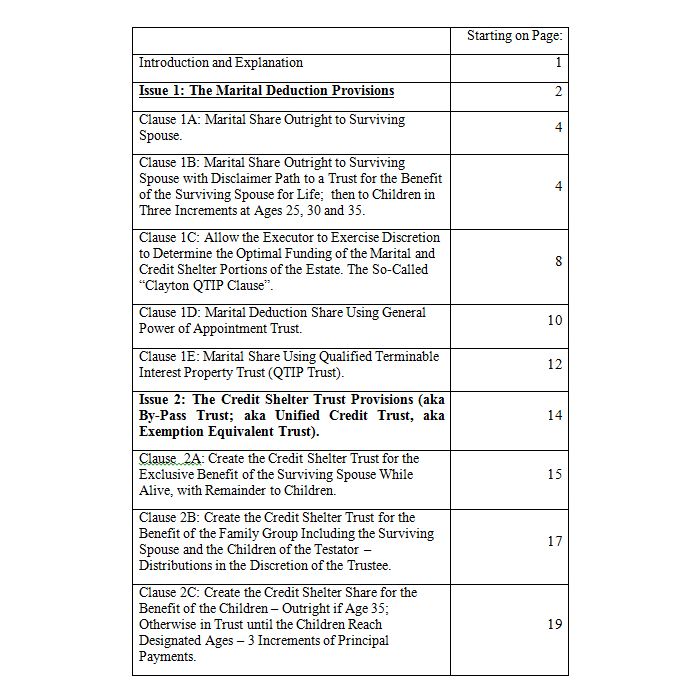
ISSUE 1: The Marital Deduction Provisions
CLAUSE 1A: Marital Share Outright to Surviving Spouse.
CLAUSE 1B: Marital Share Outright to Surviving Spouse with Disclaimer Path to a Trust for the Benefit of the Surviving Spouse for Life; then to Children in Three Increments at Ages 25, 30 and 35.
CLAUSE 1C: Allow the Executor to Exercise Discretion to Determine the Optimal Funding of the Marital and Credit Shelter Portions of the Estate. The So-Called “Clayton QTIP Clause”.
CLAUSE 1D: Marital Deduction Share Using General Power of Appointment Trust.
CLAUSE 1E: Marital Share Using Qualified Terminable Interest Property Trust (QTIP Trust).
ISSUE 2: The Credit Shelter Trust Provisions (aka By-Pass Trust; aka Unified Credit Trust, aka Exemption Equivalent Trust).
CLAUSE 2A: Create the Credit Shelter Trust for the Exclusive Benefit of the Surviving Spouse While Alive, with Remainder to Children.
CLAUSE 2B: Create the Credit Shelter Trust for the Benefit of the Family Group Including the Surviving Spouse and the Children of the Testator – Distributions in the Discretion of the Trustee.
CLAUSE 2C: Create the Credit Shelter Share for the Benefit of the Children – Outright if Age 35; Otherwise in Trust until the Children Reach Designated Ages – 3 Increments of Principal Payments.
CLAUSE 2D: Create the Credit Shelter Share for the Benefit of the Children – Outright Distributions to Children.
CLAUSE 2E: Impose a Limit (Maximum) on the Credit Shelter Gift and a Minimum on the Marital Deduction Funding to Assure a “Reasonable” Division between the Two Shares of the Estate.
ISSUE 3: Portability Provisions.
CLAUSE 3A: Portability of the Deceased Spousal Unused Exemption – Mandatory Election by the Executor (or Personal Representative) of a Will.
CLAUSE 3B: Portability of the Deceased Spousal Unused Exemption – Mandatory Election by the Trustee of a Trust.
CLAUSE 3C: Portability of the Deceased Spousal Unused Exemption –Discretionary Election by the Executor (or Personal Representative) of a Will.
CLAUSE 3D: Portability of the Deceased Spousal Unused Exemption –Discretionary Election by the Trustee of a Trust.
ISSUE 4: Generation-Skipping Transfers
CLAUSE 4A: GST Marital and Family Trust Provisions, Including Reverse QTIP Language, and Administrative Provisions
BONUS INCLUSION: 2012 Estate and Tax Client Planning Letter
Author:
Steven G. Siegel is president of The Siegel Group, a Morristown, New Jersey - based national consulting firm specializing in tax consulting, estate planning and advising family business owners and entrepreneurs. Mr. Siegel holds a BS from Georgetown University, a JD from Harvard Law School and an LLM in Taxation from New York University.
He is the author of several books, including: Planning for An Aging Population; Business Entities: Start to Finish; Taxation of Divorce and Separation; Income Taxation of Estates and Trusts, Preparing the Audit-Proof Federal Estate Tax Return, Putting It Together: Planning Estates for $5 million and Less, Family Business Succession Planning, Business Acquisitions: Representing Buyers and Sellers in the Sale of a Business; Dynasty Trusts; Planning with Intentionally-Defective Grantor Trusts; The Federal Gift Tax: A Comprehensive Analysis; Charitable Remainder Trusts, Grantor Trust Planning: QPRTs, GRATs and SCINs, The Estate Planning Course, The Retirement Planning Course, Retirement Distributions: Estate and Tax Planning Strategies; The Estate Administration Course, Tax Strategies for Closely-Held Businesses, and Tort Litigation Settlements: Tax and Financial Issues.
Mr. Siegel has lectured extensively throughout the United States on tax, business and estate planning topics on behalf of numerous organizations, including National Law Foundation, AICPA, CCH, National Tax Institute, National Society of Accountants, and many others. He has served as an adjunct professor of law at Seton Hall and Rutgers University law schools.
The Siegel Group provides consulting services to accountants, attorneys, financial planners and life insurance professionals to assist them with the tax, estate and business planning and compliance issues confronting their clients. Based in Morristown, New Jersey, the Group has provided services throughout the United States. The Siegel Group does not sell any products. It is an entirely fee-based organization.
Contact the Siegel Group through its president, Steven G. Siegel, e-mail: [email protected].